Comfortable rooms
Shared rooms with their own bathrooms, individual beds and secure personal storage. A clean, maintained environment where residents are treated with respect.
A proposed transitional home for men on parole
A safe place to live. Three exceptional meals a day. Connections that help people take their next step.
Who’s Hungry is developing a transitional home for men on parole after release from prison. A stay of up to 12 months would give residents a stable place to pursue work, build savings and prepare for housing they can sustain.
Why we’re building this
Rebuilding a life takes more than determination. Without stable housing, reliable meals and access to opportunity, even the next step can be difficult.
Our vision is to bring those essentials together: a welcoming transitional home, a thoughtful daily routine, and people who care about what happens next.
We want residents to have space to rest, share a meal, reconnect with others and work toward greater independence. Residents would remain responsible for meeting their parole conditions. We would help them connect with outside providers for the services, classes and support in their individual plans.
The home we envision
Shared rooms with their own bathrooms, individual beds and secure personal storage. A clean, maintained environment where residents are treated with respect.
A shaded outdoor dining and social area, thoughtfully arranged for meals, conversation and time together. The final design would meet accessibility and site requirements.
Preparation for paid union apprenticeships and skilled trades, with community participation and other employment routes suited to each resident.
Food is how we show care
Three meals prepared with pride from our food truck. A dependable routine, generous plates and a table where people feel welcome.
Our planned meal program. Service times and menus will be finalized before the home opens.
Come down during the breakfast window and have your meal made to order. Choose from eggs, homemade sausage patties, home fries, English muffins and pancakes. French toast or bacon can make occasional appearances.
Build a plate or turn the savory ingredients into a breakfast burrito, with cheese optional. Hot breakfast service ends at 8 AM; fruit or another simple option would remain available afterward.
A lighter midday meal with rotating choices from our five favorites: burgers, hot dogs, sausage with peppers and onions on a roll, fried chicken sandwiches and grilled chicken sandwiches. Fries or homemade potato chips on the side; patty melts and grilled cheese can join the rotation.
Residents heading out for work, volunteering or appointments could arrange a packed lunch before leaving. Hot lunch service would be planned around who is expected home.
Dinner is our family-style buffet: residents and staff sharing a generous meal, with planned first portions and a little extra. Everyone gets served before seconds are offered.
Seven themes keep the week interesting. Recipes change within each theme, with simple, festive touches on the serving table.
Fish, ribs, meatloaf and other favorites would rotate into the menus. These are sample spreads; seasonal ingredients, residents’ feedback and the food budget would guide the choices.
Dinner is also a chance to unwind, talk about the day and celebrate progress. How is work or preparation going? Is it a good fit? What would you like to work toward next?
Residents can share, ask for help or simply eat and listen. Personal concerns can be discussed privately. We listen to each person’s goals and help them explore connections and practical next steps, while encouraging them to take the lead.
We would discuss dietary needs and allergies with residents before service and plan suitable alternatives. Packed meals and arrangements for approved work or appointment schedules would help residents stay connected to the meal program.
Up to a year of support
Stable housing while residents build their next step.
Who’s Hungry is being developed for men returning from prison and living on parole. The proposed stay is up to 12 months, with job preparation and planning for independent housing beginning at intake.
Our preferred employment route is paid union work. We plan to build relationships with unions, registered apprenticeship programs and employers so residents can prepare, apply and compete for paid opportunities in skilled trades. Admission, wages and job availability are determined by each program or employer; no placement is guaranteed.
Paid opportunities would be pursued as soon as a resident is eligible. A year of unpaid work is not a prerequisite. Freely chosen community volunteering could help residents build routine and connections while they prepare for work, alongside other suitable employment routes when union entry is not immediately available.
Residents would connect with outside providers for classes, recovery support, identification, transportation and benefits appropriate to their individual needs and parole conditions. Benefits eligibility depends on the person and living arrangement; it is not assumed to fund the home or meal program.
Move-on planning would focus on income, savings and sustainable housing. Jobs, housing outcomes and parole discharge are not guaranteed. Only the responsible authorities can change supervision requirements or discharge someone from parole.
Relationships we want to build
We want to connect with unions, registered apprenticeship and pre-apprenticeship programs, and employers offering paid routes into skilled trades. We also plan to explore appropriate reentry resources and community-service opportunities with organizations such as St. Joseph Center and its Bread & Roses Café.
The founders’ work serving meals through St. Joseph Center inspired this separate organization. Employment there does not establish a Who’s Hungry partnership or a resident placement.
No union, employer, community placement or referral agreement is currently confirmed. Each outside organization sets its own eligibility and availability. Community volunteering would be freely chosen and would not replace paid employees or serve as unpaid labor for commercial employers.
Respect and accountability
Before opening, we would establish written house rules, applicable curfews, check-ins, safety procedures and a clear response to rule violations. Residents would be responsible for their individual parole conditions and agreed participation plans. Each resident’s supervision requirements would be confirmed individually.
The operating team would document concerns, respond to immediate safety needs and communicate with parole officers when required by law, individual supervision conditions or agreed program procedures. Support does not mean overlooking serious problems. Staff would follow defined reporting and escalation procedures; they would not act as law enforcement or make parole decisions.
The check-in method is still to be decided. In-person checks, a dedicated security role and technology-assisted check-ins are possibilities to evaluate, not arrangements already in place. Any method must fit residents’ supervision conditions, safety needs and privacy.
Final intake, privacy, reporting, complaint and move-out policies must be completed before residents are accepted.
A property to evaluate
One preliminary concept uses an 18-room motel on South Broadway with an adjacent parking parcel for possible dining and gathering space. No property has been secured; availability, price and suitability must be confirmed.
The concept considers up to 54 residents. The actual capacity, housing use, food-truck setup and common areas would depend on professional review and required approvals.
One shared fundraising goal
$4M
Our fundraising goal for the first property, opening needs and an operating reserve. This is a funding target, not money already raised or a fully priced budget.
Donations, fundraising pop-ups, possible food-truck events and larger gifts would help make the first home possible. No event dates are confirmed. The nonprofit would own the property; charitable gifts provide no ownership stake, repayment or financial return.
We plan to evaluate an existing motel or similar property, use suitable rooms and bathrooms, and furnish it for approved occupancy. The food truck is already owned. The acquisition, permitted use, capacity, food setup and required safety work must be reviewed before purchase.
Founder compensation and the cost of reliable daily operations belong in the budget from the start. Neither the purchase nor a projected occupancy level establishes that the home can afford them.
These are planned uses, not allocated subtotals. We will publish the costed budget and revise the plan if the funding required differs from the goal.
The goal is equal annual take-home pay of $100,000 for each of the three working founders. That is $300,000 in combined net pay, not a $300,000 payroll budget. Gross salaries would need to cover applicable employee taxes and deductions; employer payroll taxes, benefits, insurance and other employment costs are additional.
Compensation has not been approved or guaranteed. An independent board review of duties, comparable compensation and available funding must determine a reasonable package before employment commitments are made.
We are developing the operating model, including possible program payments, donations, fundraising income and any permitted resident contributions. No bed-payment rate, referral agreement, guaranteed occupancy or recurring operating revenue has been secured. Fundraising event proceeds must account for event expenses.
The first property may have little or no surplus after operating costs and compensation, but that is an assumption to test, not a forecast. The cash plan must provide an operating reserve rather than assume the organization can safely finish the year with no cash. We do not yet claim that the first building can support the founders’ pay targets.
Discretionary renovations and additional properties would follow a review of actual income, costs, resident outcomes, cash reserves and staffing capacity. Necessary repairs and safety work cannot wait for expansion. A second or third property is a future phase, not a funded commitment within the first-home goal.
Learn from the first home
No property is operating yet. The first step is to fund, acquire and open a suitable home. James, Shehz and Cristela plan to share its daily work: meals, resident check-ins, house rules, incident documentation, property coordination and administration.
The founders would use the first home’s actual workload, income and costs to decide what support is needed. Before opening, they must establish workable schedules, training and backup arrangements that account for their availability and the home’s requirements.
A second property would follow only when operating income or additional fundraising can support it. The number, timing and roles of new hires would depend on what the founders learn while running the first home. There is no fixed employee-per-building formula or expansion date.
Moving the founders’ time from daily service toward running the wider organization is a longer-term aim. Any change would depend on reliable operations, adequate funding and trained staff who can take on the work.
People and accountability
Who’s Hungry is an independent nonprofit founded by James Cunningham, Shehzad “Shehz” Peermahomed and Cristela Alvarado. Their work feeding people experiencing homelessness through St. Joseph Center helped inspire a different focus here: transitional housing and pathways toward paid work for men returning from prison. All three are equal co-founders with shared responsibility.
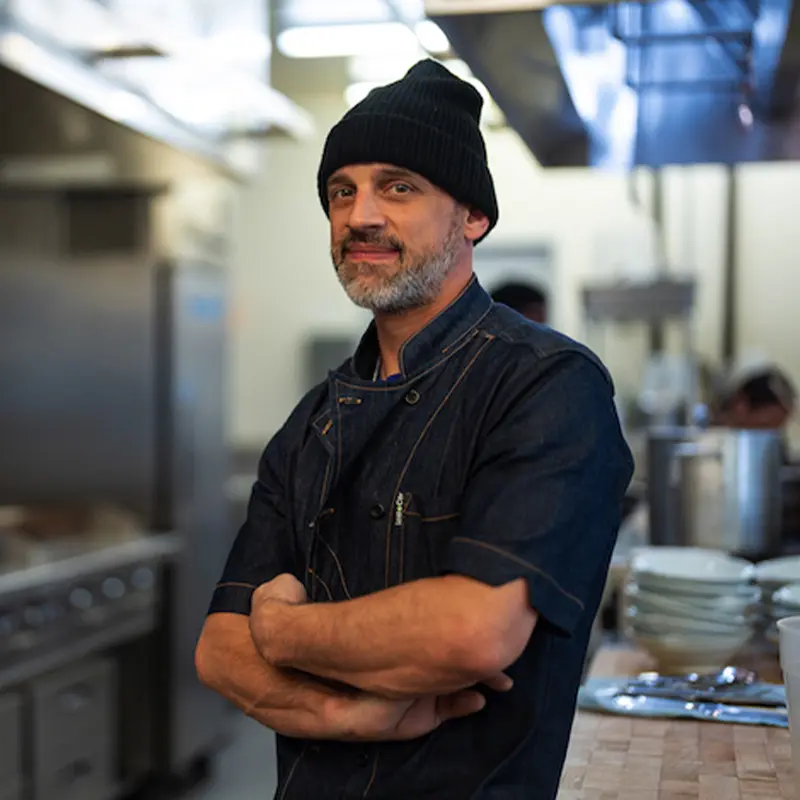
James Cunningham is a chef and equal co-founder of Who’s Hungry. As Executive Chef and Program Manager at St. Joseph Center’s Bread & Roses Café in Venice, he brings professional cooking, daily service and care for people experiencing homelessness together at the same table.
James’s work with Chef Michele Ragussis spans more than a decade. He met Michele in Rockland, Maine, and worked under her as sous-chef at The Pearl, a restaurant at the end of the pier. He then followed her to Central House at The Crown & Anchor in Provincetown, Massachusetts. Cape Cod LIFE documented their work together in 2016.
James continues to work under Michele on culinary jobs and joins her for annual cooking demonstrations at Mohegan Sun’s Sun Wine & Food Fest. Festival coverage identifies him as “Chef Jimmy.”
In February 2024, ABC7 honored James as an Early Riser for his work preparing meals and creating a welcoming dining experience at Bread & Roses. That same belief—that good food and respectful service belong together—helps shape Who’s Hungry’s vision for a transitional home.
James shares leadership with fellow co-founders Cristela and Shehz. Together, they are developing a home with exceptional meals, practical community connections and room for residents to build their next chapter.
His standard is simple: prepare food intentionally, serve it with dignity, and come back tomorrow.
See James’s photos, video and press coverage
With over 15 years of experience in the food industry, Cristela Alvarado has built her career around her passion for food, hospitality, and serving the community. For the past 10 years, she has owned and operated a food truck and catering business, gaining hands-on experience in food preparation, catering, events, and day-to-day operations.
She has also spent the past four years working in the nonprofit sector, where she has developed a deeper understanding of community needs and the importance of creating meaningful impact. Cristela is excited to bring her experience, dedication, and passion for food and community to Who’s Hungry and contribute to the work the founders are doing together.
Shehzad “Shehz” Peermahomed is a Co-Founder of Who’s Hungry Inc., a nonprofit developing transitional housing for men on parole after prison, with meals, structure and planned pathways toward paid union employment and apprenticeships.
With more than a decade of experience in restaurant operations and nonprofit food service, Shehzad currently serves as a Chef and Workforce Development Mentor at Bread & Roses Café, where he helps prepare thousands of nutritious meals each month while mentoring individuals working to rebuild their lives. His experience spans restaurant management, catering, culinary operations, and nonprofit leadership, giving him a unique understanding of how food can strengthen communities and create lasting change.
Through Who’s Hungry Inc., Shehzad is committed to bringing nourishment, stability, and hope to people rebuilding their lives. Alongside fellow co-founders James and Cristela, he will help create a welcoming home with outstanding meals and community connections that can open doors to work.
Meet James through photos, video and press coverage
Our commitment is shared leadership and equal founder compensation, with a planning target of $100,000 annual take-home pay each. The funding plan explains the additional payroll costs, independent review and affordability checks required.
We intend to share clear progress reports, explain how funds are used and update the plan when the evidence changes.
James in the community
Meet co-founder Chef James Cunningham through his work at Bread & Roses Café and on stage with Chef Michele Ragussis at Mohegan Sun.
Selecting play loads YouTube. Watch on YouTube
ABC7 Early Riser · February 2, 2024
ABC7 recognized James for showing up before sunrise to prepare meals for neighbors experiencing homelessness, with hospitality and dignity at the heart of the service.
ABC7 reporting, shared on St. Joseph Center’s YouTube channel.
Read the ABC7 storyMohegan Sun · Sun Wine & Food Fest
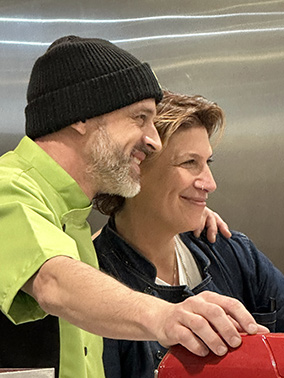
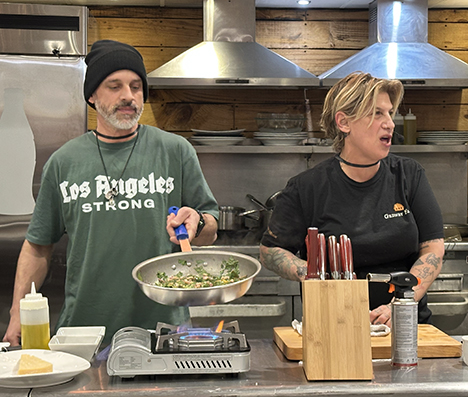
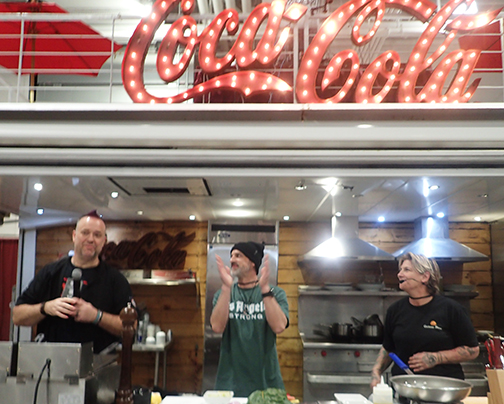
James joins Michele for annual cooking demonstrations at Mohegan Sun, continuing a working relationship that began at The Pearl in Rockland, Maine, and took them to The Crown & Anchor in Provincetown. These moments from the 2023 and 2025 festivals capture them doing what they love. Luxury Experience’s coverage names James as “Chef Jimmy.”
St. Joseph Center
St. Joseph Center’s history includes James’s arrival at Bread & Roses Café in 2017.
Explore the historyThe Oracle · May 30, 2024
A community feature with a kitchen photo and an interview with James about service and respect.
Read the featureCape Cod LIFE · August 2016
A profile of Michele Ragussis describes James’s work as her sous-chef, making pastas and desserts.
Read the profileThese stories document James’s culinary and community work. Bread & Roses Café is a St. Joseph Center program; Who’s Hungry is a separate nonprofit. Photos and reporting are credited to their original publishers.
Where we are today
Who’s Hungry is established, and the operational, licensed food truck is already owned. The proposed housing program is still in development.
Confirm an appropriate property and approved capacity, establish the reentry service and payment arrangements, secure capital, complete any work required to open, furnish the rooms, and finalize founder shifts, training and funded backup coverage. An opening date has not been set.
The proposed home focuses on men returning from prison, with stable housing, meals and preparation for paid employment. It does not include a culinary training school. Our preferred employment route is paid union apprenticeships and skilled trades; community volunteering would be a separate opportunity.
No. Housing is not yet operating. Future admissions would follow the home’s finalized eligibility, intake and parole-related requirements. No resident applications are being accepted through this website.
Accountability from the start
Who’s Hungry’s federal nonprofit recognition is established. View our IRS determination letter.
Once funding begins, we intend to share quarterly updates on money received, spending, reserves and progress toward opening. During operations, reporting would cover occupancy, meals served and aggregate progress toward employment and move-on housing, while protecting residents’ privacy.
Housing and meals will not depend on appearing in publicity. Storytelling will require separate, freely given permission. Founder compensation and related-party spending will receive independent review; operating surplus stays with the nonprofit’s mission.
We will track restricted gifts separately, reconcile finances, establish purchasing approvals and provide a private feedback route before opening. Required employee training will be paid, and schedules will reflect safe workloads.
Help make the next step possible
We welcome introductions to donors, unions, registered apprenticeship programs, employers, housing and reentry professionals, and community organizations. Our shared launch fundraising goal is $4 million. Contact info@whoshungryproject.org to get involved. Donations opening soon. Housing applications are not open.